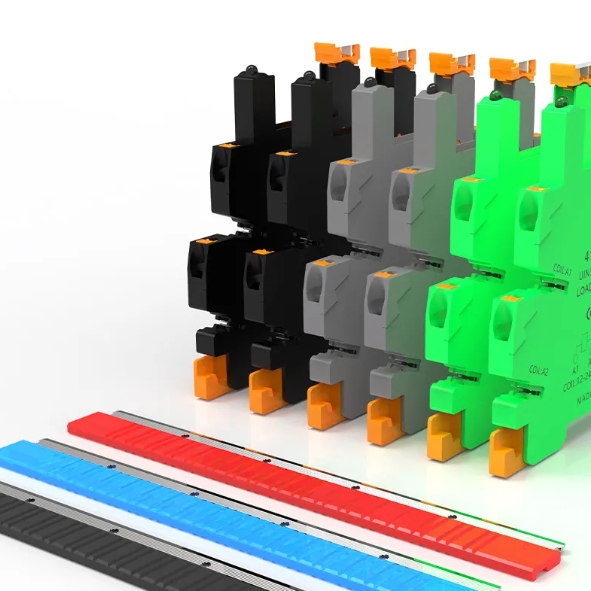
Relay Socket: How to Choose the Right Base for a Slim Relay
In a control cabinet, the relay gets all the attention. It is the component that switches the load, so datasheets and selection guides focus on its coil voltage and contact rating. The relay socket — the base the relay plugs into — rarely gets the same attention, yet it decides how fast a panel is wired, how easily a failed relay is replaced, and how safely the circuit is separated from the operator. Choose the wrong base and even the best relay becomes hard to install and hard to service.
What a relay socket actually does
A relay socket is the interface between the relay and the rest of the panel. It holds the relay on a DIN rail, brings the coil and contact terminals out to screw or push-in wire connections, and lets the relay be pulled out and replaced without touching a single wire. That last point matters most in service: a relay that has reached the end of its electrical life can be swapped in seconds, while the wiring — and the cabinet's labelling — stays exactly where it was.
Dacheng's RD41F socket family is built for the RD41F slim relay, a 5 mm relay rated 6 A at 250 VAC. The socket is only 6.2 mm wide, so a full row of relay channels keeps the same slim footprint as the relays themselves. It is rated 250 VAC and 6 A, with an ambient temperature range of -35 °C to +70 °C, and it meets IEC 61984 with CE certification.
Screw, push-in or PCB — pick the terminal first
The first choice is how wires connect to the socket, because it decides wiring speed and long-term reliability.
The RD41F-1Z-C2 is the screw-terminal version. Wires are clamped with a screw tightened to 0.8–1.0 N·m, with a 7 mm stripping length and phosphor copper inserts. Screw terminals suit panels that are wired once and expected to stay untouched for years, and they accept a wide range of wire sizes.
The RD41F-1Z-C4 is the push-in (spring-clamp) version. Wires are pushed straight in with no screwdriver and no torque setting, which cuts wiring time sharply when dozens of channels are installed in one cabinet. It weighs about 27 g, against about 29 g for the screw version.
The RD41F-1Z-A1 is the PCB-mount version, at only about 4 g, for relays soldered directly onto a board rather than mounted on a rail. All three share the same 250 VAC / 6 A rating, so the choice is about installation, not about electrical capacity.
Protection and insulation are part of the socket
A good socket does more than hold the relay. The RD41F sockets carry a built-in protection circuit that provides power indication, line protection and an extended input voltage range, so the same socket accepts (6–24) V, (48–60) V or (110–240) V AC/DC input, with matching coil voltages of (6–24) VDC, (48–60) VDC or 60 VDC. Dielectric withstand voltage reaches 4,000 VAC and insulation resistance is 1,000 MΩ, keeping the control side safely separated from the load side. Finger protection is built in, and a relay ejector with a lock keeps the relay from falling off while making replacement easy.
The shell is PA6+G30F flame-retardant nylon, a material chosen to survive the heat of a crowded cabinet without softening or deforming.
Accessories that save wiring time
In a multi-channel cabinet, the small extras decide how fast the job goes. Marker plates (41F-M and 41F-M1) identify each channel, and plug-in connection strips (41F-H in blue, 41F-HR in red, 41F-HB in black for the screw version; 41F-H1 series for the push-in version) jumper the common supply across neighbouring sockets instead of wiring each one separately. The connection strip is marked for a total current of 36 A at 250 V maximum. For a panel builder wiring forty identical channels, that is the difference between a morning's work and a full day.
What to check before you order
Four things decide whether a socket fits: the relay model it must accept (here the RD41F slim relay), the terminal type your wiring team prefers (screw for a fit-and-forget panel, push-in for fast multi-channel builds, PCB for board mounting), the input voltage range against your control supply, and the accessories — marker plates and connection strips — that match the socket version you choose. Get those four right, and the socket disappears into the background, which is exactly what it should do: the relay switches, the socket holds, and the cabinet keeps running.
Get in touch
Wenzhou Dacheng Zhixin Electric Co., Ltd. supplies the RD41F relay socket family — screw, push-in and PCB types — with CE certification, together with matching RD41F slim relays, marker plates and connection strips. For datasheets, drawings or a quotation, contact us on WhatsApp / Tel: +86-13396957276 or by email: selinaye0812@gmail.com.