Push-in Relay Socket: Faster Wiring for Slim Relay Panels
 In panel building, wiring time is money. A control cabinet with hundreds of slim relays can take a full day to wire by hand when every connection needs a screwdriver, a torque check and a second look. A push-in relay socket changes that equation: the wire goes in, the spring holds it, and the connection is done. For distributors, panel builders and system integrators working with slim relays, that speed is the main reason to look at push-in sockets.
What a push-in socket does differently
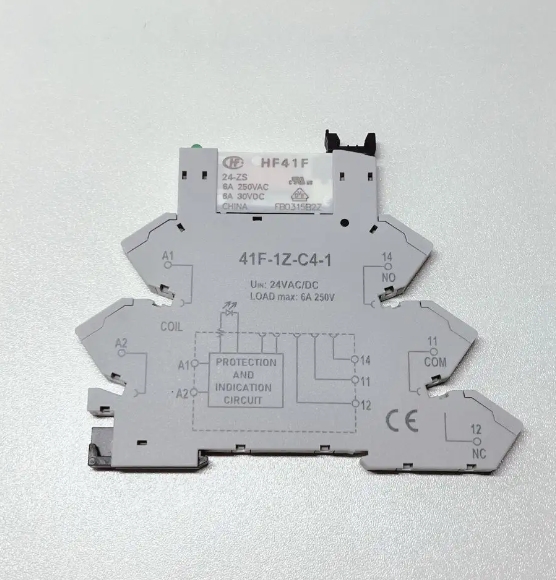
A push-in socket uses a spring terminal instead of a screw. The installer pushes a stripped wire into the terminal and the spring clamps it in place. No screwdriver, no torque setting, no loose screw to find later. Removal is just as simple: press the release lever and pull the wire out. The Dacheng RD41F-1Z-C4 is a push-in socket built for the RD41F slim relay, rated 250VAC and 6A, in a 6.2 mm wide body that matches the 5 mm relay it carries. It works from -35°C to +70°C, so it suits the same cabinets as the relay itself.
Built for fast, repeatable wiring
Push-in terminals give the same result on the first wire and the hundredth. Every connection is made with the same spring force, so there is no variation between installers and no connection left half-tightened at the end of a long shift. That consistency matters in projects where dozens of identical panels are built to the same drawing. The socket accepts a 7 mm stripped wire, and the relay itself is easy to replace: a built-in ejector and lock let a technician swap a relay without tools and without disturbing the wiring.
Safety built into the base
A socket is not just a holder. The RD41F-1Z-C4 offers a dielectric withstand voltage of 4000VAC and an insulation resistance of 1000MΩ, with finger protection on the terminals and a built-in protection circuit that provides power indication, line protection and an extended input voltage range. The shell is PA6+G30F flame-retardant nylon, and the socket is designed to IEC 61984. Input voltage covers (6-24), (48-60) and (110-240)V AC/DC, so one socket family serves control voltages from low-voltage DC logic up to mains-level AC.
Accessories that cut wiring time further
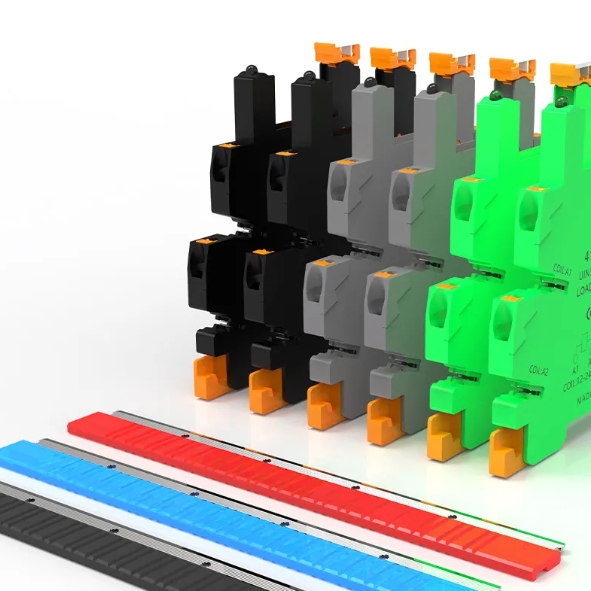
Push-in sockets work best as a system. Connection strips such as the 41F-H1 series link neighbouring sockets on the same rail, sharing a common supply without a separate wire for every point; each strip is marked for a total current of 36A at 250V maximum. Marker plates (41F-M, 41F-M1) label each socket, so the panel stays readable during commissioning and later maintenance. Together, the socket, the strip and the marker turn a row of slim relays into a tidy, documented interface.
Push-in or screw — which one fits your panel?
Dacheng offers the same slim relay base with screw terminals too (RD41F-1Z-C2 and RD41F-1Z-C2N, tightened to 0.8-1.0 N·m). Screw sockets suit panels that are wired once and rarely touched, and installers who prefer a visible screw. Push-in sockets suit volume panel building, fast commissioning and projects where wiring speed decides the schedule. Both carry the same 6A 250VAC rating and the same protection features, so the choice is about how the panel is built, not about performance.
What to check before you order
Match the socket to the relay first: the RD41F-1Z-C4 is made for the RD41F slim relay. Check the input voltage range against your control voltage, confirm the coil voltage of the relay you plan to use, and allow for the 6.2 mm width per point when you plan the DIN rail. For large orders, ask about the connection strips and marker plates at the same time, so the whole row arrives as one matched set.
Get in touch
Wenzhou Dacheng Zhixin Electric Co., Ltd. supplies slim relays and relay sockets for panel builders, distributors and system integrators worldwide. All products are CE certified. To request a quotation or samples, contact us on WhatsApp / Tel: +86-13396957276, or by email: selinaye0812@gmail.com.