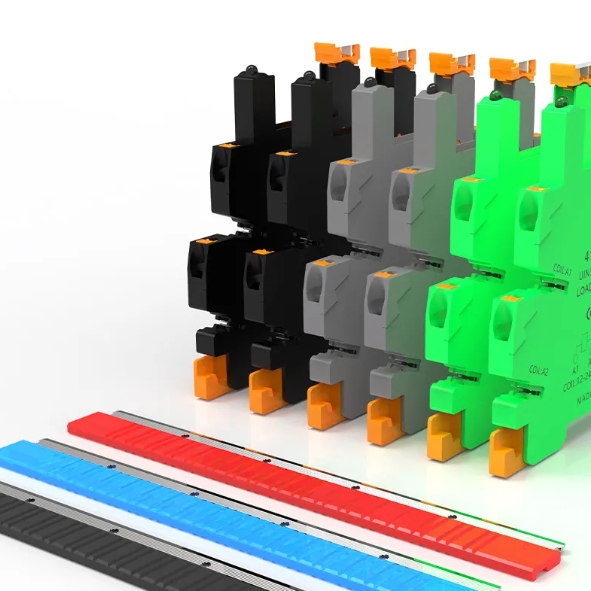
PCB Relay: How to Choose a Compact 16A Relay for Control Boards
On a control board, space is measured in millimetres and every component earns its place. The relay that switches the load is often the largest part on the board, yet it is also the part a designer is least willing to compromise on: it must carry real current, isolate the control circuit from the load, and survive years of switching. That is the job of a PCB relay — a power relay designed to be soldered straight onto the printed circuit board.
What makes a relay a PCB relay
A PCB relay has no plug-in base and no DIN rail. Its pins go through the board and are soldered in place, so the relay becomes part of the board itself. The connection is permanent, vibration-proof and free of the contact resistance a socket can add over time. For equipment built in volume — control boards, timers, HVAC controllers, power supplies — that permanence is the point: the relay is assembled with the rest of the board in one production step, and there is nothing to work loose in service.
Dacheng's RD115F series is built for exactly this use. It is a compact power relay, 29 mm long and 12.7 mm wide with a low profile of only 15.7 mm, weighing about 13.8 g. A version that meets reflow soldering requirements is available, so the relay can go through the same surface-mount line as the rest of the board, and a matching socket is available for designs where the relay still needs to be replaceable.
Real power in a small footprint
Small does not mean light duty. The RD115F switches 16 A in its single-pole version (1NO1NC) and 8 A in its two-pole version (2NO2NC), at 220 VAC or 24 VDC resistive load, with a maximum switching voltage of 250 VAC / 30 VDC. Maximum switching current reaches 16 A on the single-pole type, and maximum switching power is up to 4,000 VA. That is enough for contactors' coils, small motors, heaters, solenoid valves and lighting loads — the everyday switching jobs on an industrial control board — from a relay that takes up less board area than a terminal block.
Contact resistance is 100 mΩ or less, so the relay adds almost no loss of its own, and the contact form is available as one changeover group (1Z) or two changeover groups (2Z), letting one relay switch two independent circuits at once.
Easy to drive, quick to respond
A PCB relay is only useful if the board can drive it without extra circuitry. The RD115F coil is rated at about 400 mW, with DC coil voltages of 5, 12 and 24 V — the standard logic and control voltages found on most boards. Operate time is 15 ms or less and release time is 8 ms or less, so the relay keeps up with normal control sequencing, and coil temperature rise is limited to 55 K.
An LED version is available as an ordering option, giving a visible indication of the relay state on the board — useful during commissioning and fault-finding, when a quick look beats a meter reading.
Insulation and endurance
Isolation is the relay's other job, and the RD115F is specified for it: 5,000 VAC dielectric strength between coil and contact for one minute, 2,000 VAC between contact groups and 1,000 VAC between open contacts, with insulation resistance of 1,000 MΩ at 500 VDC. The relay is sealed in a plastic, flux-resistant package, so wave soldering and board washing do not contaminate the contacts, and it operates from -40 °C to +70 °C at 35% to 85% relative humidity.
Endurance is rated at 20 million mechanical operations, with electrical life of 100,000 operations at the standard duty cycle. On a board that may run for a decade, that margin is what keeps the relay off the service list.
What to check before you order
Four things decide whether a PCB relay fits your board: the contact form your circuit needs (1Z for a single changeover, 2Z for two circuits), the coil voltage your board supplies (5, 12 or 24 VDC), the load current and voltage against the 16 A / 250 VAC rating, and the assembly method — direct soldering, a reflow-compatible version, or a socket for field replacement. Get those four right, and a compact PCB relay does the job of a much larger plug-in relay, leaving board space for everything else the design still needs.
Get in touch
Wenzhou Dacheng Zhixin Electric Co., Ltd. supplies the RD115F PCB relay in 1Z and 2Z contact forms with 5, 12 and 24 VDC coils, with CE certification, together with matching relay sockets. For datasheets, drawings or a quotation, contact us on WhatsApp / Tel: +86-13396957276 or by email: selinaye0812@gmail.com.